
Doors, joinery, staircases, furniture and cabinet fronts
HVLP Spray Painting in County Down
HVLP is the slow gun. It puts down less material per minute than anything else we own, and it is still the only thing we will point at a panelled door, a spindle or a cabinet front, because it is the system that atomises finely enough to survive being looked at from a foot away.
Picking the right gun for the surface
Low Pressure, High Transfer, Fine Finish
People ask which is better, and the question does not have an answer because the two systems are built for opposite problems. HVLP stands for high volume, low pressure. A turbine or a compressor pushes a large volume of air through the cap at a low pressure, commonly under ten pounds per square inch, and it is that moving air, not fluid pressure, that shears the coating into droplets. The droplets are small and they leave the cap gently, so they settle onto the surface instead of hitting it and bouncing.
Two things follow from that. The first is atomisation quality. Smaller, more uniform droplets flow together into a tighter film, which is why a spindle or a panelled door sprayed on HVLP reads as one surface rather than as paint that has been applied. The second is transfer efficiency, which is the share of what leaves the gun that actually ends up on the workpiece. Because so little rebounds, the amount of mist floating about the room is a fraction of what a high pressure system produces.
That second point is the reason we can work inside a house that people are still living in. A staircase in an occupied terrace in Downpatrick, a run of doors in a bungalow near Killough, a fitted wardrobe in a rented flat in Belfast. In every one of those the client is at home, the hall is still in use, and a system that filled the ground floor with airborne paint would be unworkable no matter how good the finish was.
What This Gun Is For
- Panelled and flush internal doors, frames and linings, sprayed off their hinges so edges and rebates are coated properly
- Staircases, spindles, newel posts and handrails, where every turned section has faces a brush cannot reach evenly
- Cabinet doors, drawer fronts and wardrobe fronts, which are inspected from close range every day of their life
- Skirting, architrave, window boards and picture rails, sprayed to remove the brush texture along a long straight run
- Freestanding furniture, radiator covers and shelving, refinished rather than replaced
What It Is Not For
A gable wall. A full render elevation. The walls and ceilings of an empty house. HVLP simply does not move enough material per minute to make any of those sensible, and forcing it produces a thin, patchy film and a bill made mostly of hours. Thick masonry products will not atomise at low pressure at all. If your job is a large area we will quote it on a different machine and say so plainly.
Setting the gun up for the coating
Needle, Nozzle and What the Paint Will Allow
Low pressure buys a fine finish and charges for it in fussiness. A high pressure rig will push almost anything through almost any tip. HVLP will not. The coating has to be capable of breaking up in a stream of air, and the hardware has to be sized for that specific product. Get either wrong and the result is visible from across the room.
Fluid Tip Sizes
HVLP nozzles are measured in millimetres rather than thousandths of an inch. Around 1.0 to 1.3 suits thin lacquers, stains and clear coats. Roughly 1.4 to 1.8 covers most water based primers and trim finishes. Anything heavier than that needs a wider set again, and past a point the product is simply outside what the system was built for.
Matched Sets
The needle, the nozzle and the air cap are designed as a group and they change as a group. Fitting a larger nozzle to a needle meant for a smaller one gives an inconsistent trigger response and a pattern that wanders. This is the sort of detail that never appears in a quote and shows up in the finish.
Viscosity and Thinning
Many coatings have to be let down before they will atomise properly at low pressure. We check flow with a viscosity cup and time it rather than judging by how it pours off a stirrer. Left too thick, the material spits and dries with an orange peel texture. Thinned past the manufacturer's stated limit it runs on a vertical face and the film no longer performs as the tin promises.
Pattern and Distance
The air cap can be set from a narrow round pattern for a spindle to a flat fan for a door panel, and the gun is held closer than a high pressure gun would be. Because the pattern is small, the work is a lot of short overlapping passes rather than long sweeps. That is the honest reason a staircase takes the time it takes.
Detail Work From Recent Jobs
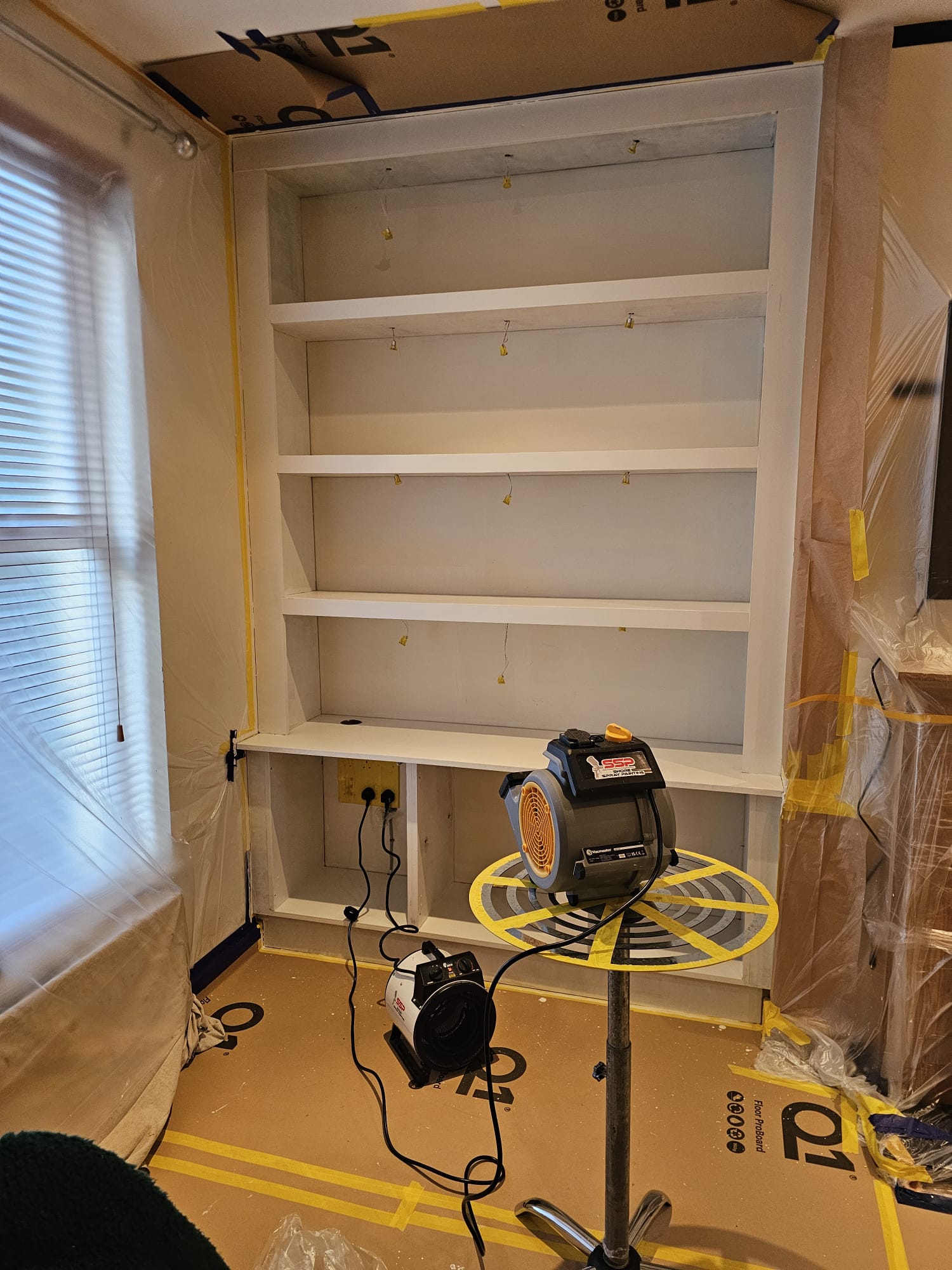
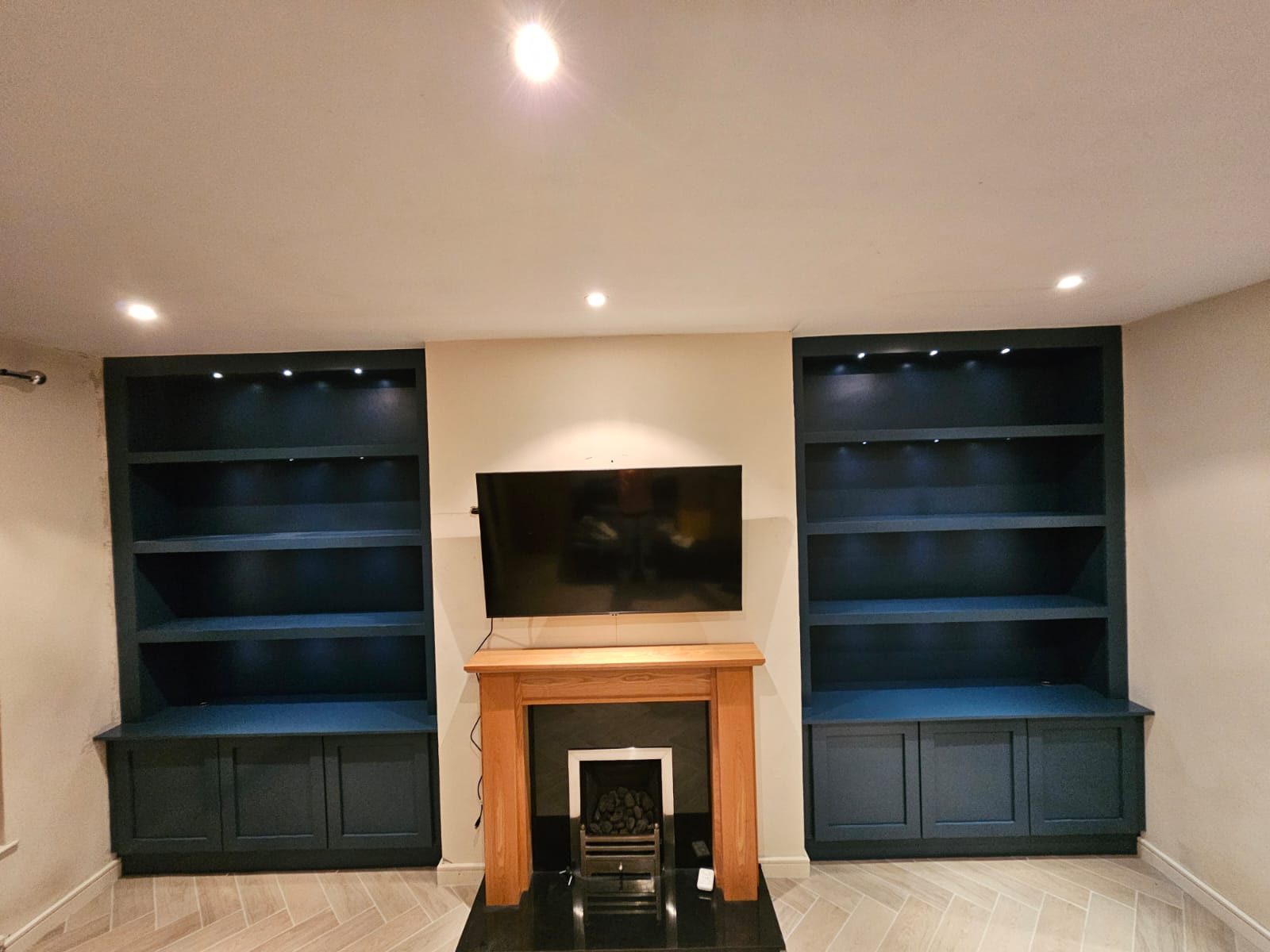
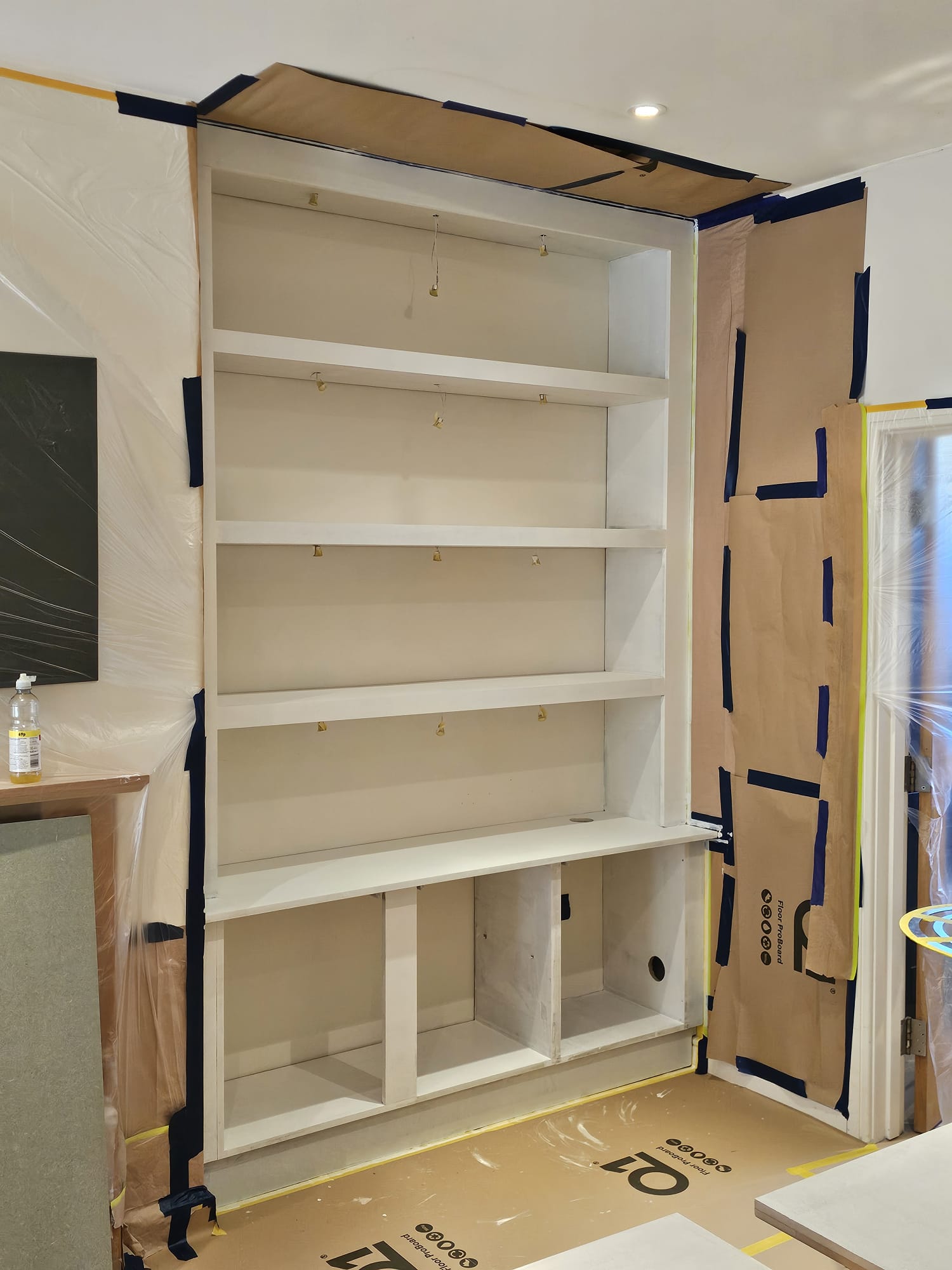
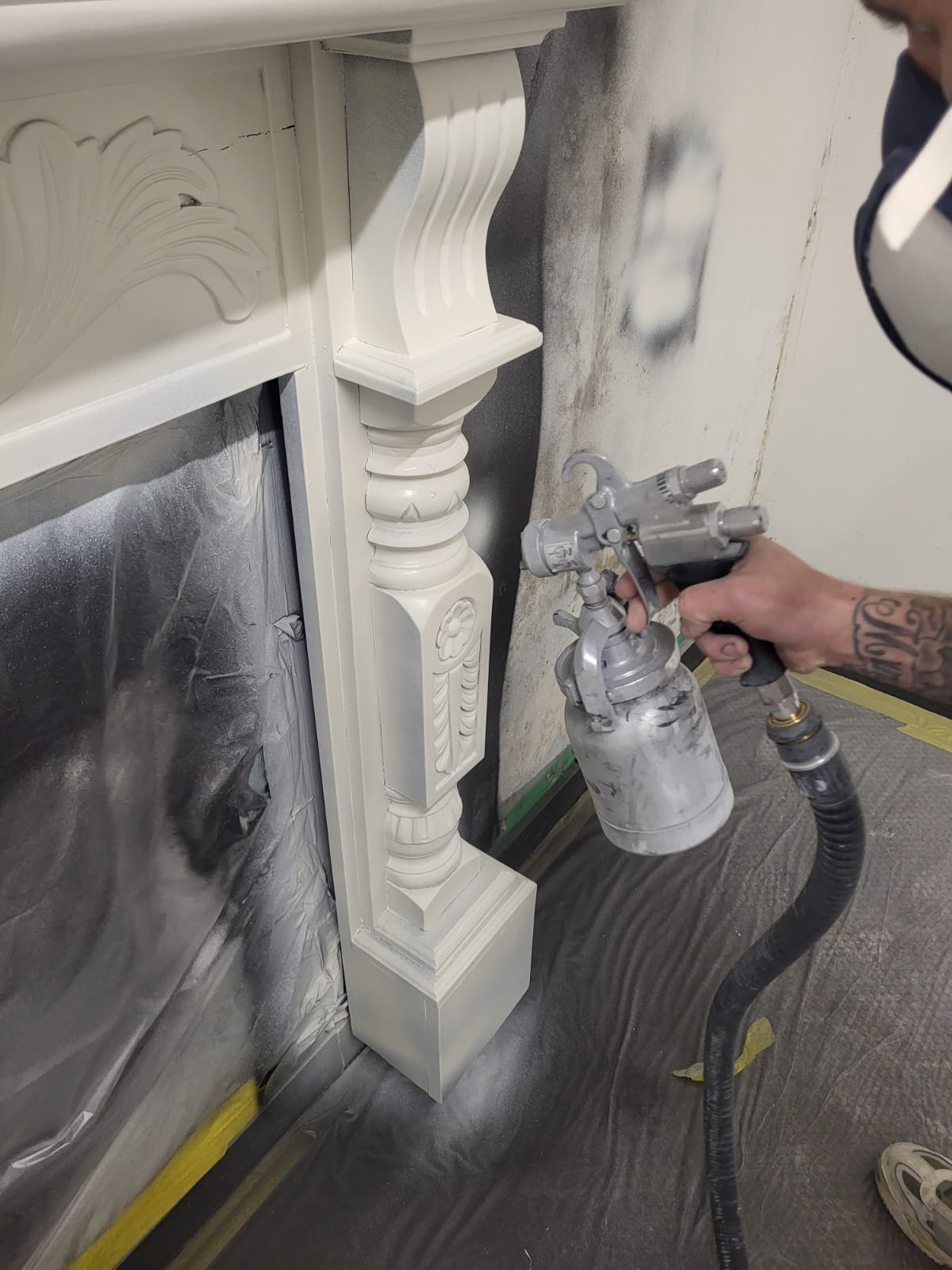
Doors, joinery and furniture sprayed on the low pressure system.
Dust Is What Ruins a Fine Finish
The finer the atomisation, the smaller the thing that can spoil it. A speck of grit that would vanish into a brushed coat sits proud of a sprayed one and catches the light every time somebody walks past. Controlling the air in the room is therefore as much of the job as controlling the gun, and it is why we treat an interior spray as a clean process rather than a decorating one.
- Vacuum, then damp down. Floors are cleaned and dampened so foot traffic is not lifting dust back into the air while a coat is still open.
- Let the room settle. After preparation we stop and wait rather than spraying straight into air that is still carrying what the sanding put there.
- Tack off between coats. Every face is wiped with a tack cloth before it is recoated, which takes minutes and saves denibbing a whole staircase.
- No sanding next door. Nobody works on abrasives in an adjoining room while a coat is flashing off, because dust travels through a doorway faster than people think.
- Warmth and a little movement. A cold room stretches flash off times and holds the film open longer, which gives dust more chance to land. We warm and gently ventilate rather than leaving a window wide open.
How a detail job runs
Six Stages in an Occupied House
A staircase and a landing of doors is commonly two to three days. A single run of fitted furniture can be one. The variable is almost never the spraying itself, it is how much preparation the existing finish needs before it will take a coat.
- Step 1
Survey and coating choice
We look at what is already on the timber, test it if there is any doubt, and pick a system that will bond to it. An old solvent finish under a modern water based one is the failure we see most, and it has to be dealt with rather than covered.
- Step 2
Room prep and containment
The working area is sheeted and screened off from the rest of the house. Because overspray is low, containment is one room or one hall rather than the whole ground floor, and you keep the use of everywhere else.
- Step 3
Remove and label
Doors come off, handles, hinges, spindle brackets and any ironmongery are taken off and bagged by location. Spraying around fittings is what gives a job that unmistakable half done look at the edges.
- Step 4
Fill, sand and tack
Dents and open joints are filled, everything is keyed back, and the dust is vacuumed and tacked off. This is the stage that decides the finish, and on old joinery it is the longest one.
- Step 5
Prime, denib and topcoat
Primer goes on, is denibbed once dry so the grain that has lifted is knocked back, and the colour follows in thin coats with a proper interval between them. Building it in light passes is what keeps the film even on a moulding.
- Step 6
Refit and snag
Once the coating is hard enough to handle, ironmongery goes back where it came from, doors are rehung and adjusted, and we walk the area with you in daylight rather than under a work light.
Related Services
HVLP is a technique rather than a room. These are the services it is usually booked as part of.
Questions we get asked
HVLP Spraying Questions
How far do you travel for detail spraying?
County Down is our base and Belfast, Lisburn and Newry are all standard. Detail work is done in your property rather than taken to a workshop, so what matters more than distance is whether there is a room we can screen off and work in for a couple of days.
How do you work out a price for this kind of work?
By item and by condition. Count the doors, the spindles and the runs of trim you want done, then tell us what state the existing paintwork is in. Two identical staircases can differ by a full day because one has sound previous coats and the other has forty years of build up that has to come back.
Are you insured to work inside an occupied house?
Yes, fully insured, with a workmanship guarantee on the finish. Working around people is the normal condition for this service rather than the exception, so containment, floor protection and agreed working hours are part of how the job is planned, not extras.
Will there be paint mist through the rest of the house?
Very little, and that is the practical reason we use this system indoors. Low pressure means most of what leaves the gun lands on the item rather than hanging in the air. We still screen the working area and protect floors, but you are not sheeting the whole house to have a staircase done.
How soon can the doors and stairs be used again?
The stairs are back in use the same evening in most cases, with the handrail treated gently. Doors are rehung once the film is hard enough to handle and reach full toughness over the following couple of weeks, so avoid slamming them or hanging anything off the back of one during that time.
If the finish is better, why not use HVLP for everything?
Because coverage rate is the trade off. Low pressure moves far less material per minute, so a surface area that airless would finish before lunch would take days and the film would still be thinner. Ask a gun to do work it is not built for and you pay for hours without getting a better result.
Does my paint need thinning before it can be sprayed?
Often yes. A coating designed for a brush is usually too thick to break up properly in a low pressure air stream, and we check it with a viscosity cup rather than guessing. Thinning is always kept inside the manufacturer's stated limit, because going past it costs you durability that you cannot see until later.
What nozzle size will you use on my job?
It depends entirely on the product. Thin lacquers and stains want a small fluid tip, most trim finishes and water based primers want a mid range one, and heavier materials want wider again. The needle, nozzle and air cap are changed as a matched set for the coating rather than left on whatever was used last.
What causes a gritty or bumpy sprayed finish?
Three things, in order of how often we see them. Dust settling into a wet coat, material that was too thick to atomise cleanly, and grain that lifted under the primer and was never denibbed back. All three are process faults, which is why the preparation and the room control matter more than the brand on the tin.
Can you spray the walls and ceilings of a room this way?
We would not recommend it. The pattern is small and the output is low, so a whole room becomes an expensive way to get a finish that nobody inspects from a foot away. Walls and ceilings are better rolled or sprayed on a higher output system, and the joinery in the same room is where this gun earns its place.
Is HVLP any use outdoors?
For small, detailed exterior items such as a front door, a porch or a set of gates, yes, provided the day is still and dry. The fine droplets that make the finish good also make it easy for a breeze to carry them off target, so on anything larger or more exposed we use a different system.
Request a Free Estimate
List the items you want sprayed, the colour and sheen you have in mind, and where you are in County Down. We will come back with a written price.
Book Your Joinery In
Tell us how many doors, spindles or units you want done and send a close photograph of the existing paintwork. We will tell you what preparation it needs and give you a realistic number of days.