
Render, gables, ceilings, fencing and industrial areas
Airless Spray Painting Across County Down
Airless moves more paint in an hour than a roller moves in a day. What it does not do is tidy up after itself, so the honest version of an airless quote is mostly masking, and the spraying is the part that finishes before lunch.
What you are actually paying for
The Spraying Is the Short Part
An airless quote confuses people because the arithmetic looks wrong. A gable that would take two days with a roller gets coated in well under an hour, and yet the price does not fall by two days. The reason is that airless drives paint at the wall hard enough that a portion of it rebounds and hangs in the air. Every window, sill, downpipe, path, car, hedge and neighbouring boundary has to be covered before the trigger is squeezed once. That covering work is the job. The colour going on is the reward at the end of it.
The machine is simple enough to describe in a sentence. A pump pushes coating along a hose to a gun and forces it through a hardened tip with a hole in it measured in thousandths of an inch. No air is introduced to the material at any stage. Pressure alone tears the stream apart into droplets, and that is why an airless rig will move a thick masonry product that would clog anything gentler.
That suits a lot of the property around here. Render, roughcast and dry dash are the default finish from Downpatrick out through the Lecale villages, and those surfaces drink paint out of a roller sleeve while still leaving pinholes in the hollows. A spray fan pushes material into the texture rather than skating over the top of it. On exposed sites near Ardglass, Killough or the Strangford shore we also read the wind before we start, because a breeze too light to bother a brush hand will carry atomised paint into a garden two doors down.
Where We Reach for It
- Render, roughcast and dry dash on full elevations, where the texture is what defeats a roller
- Ceilings and empty rooms, before flooring and furniture arrive and nothing needs cutting in around
- Fencing, sheds and timber outbuildings, where the gaps between boards would take a brush all afternoon
- Farm sheds, steelwork and profile sheeting, where the area is large and unforgiving
- Unit interiors and warehouse walls, where the value sits in finishing fast
Where It Is the Wrong Machine
A furnished sitting room, a single front door, a run of skirting in a house somebody is living in. In all three the masking would cost more than the painting and a lower pressure gun would give a better looking result anyway. We will tell you when the job in front of us wants a different tool, because a rig that is too aggressive for the work is a fast way to make a mess of somebody's home.
Tip Size and Fan Width Are the Setting
Every airless tip carries a three digit number, and that number is not a product code. It tells you the two things that decide how the coating lands. Anyone quoting airless work should be able to tell you which tip they intend to fit on your surface and why.
- The first digit is the fan. Double it and you have the approximate spread in inches when the gun is held about a foot off the surface. A 5 opens to roughly ten inches, which is a sensible width for a wall and far too wide for a window reveal.
- The last two digits are the hole. A 17 means seventeen thousandths of an inch. That figure sets how much material leaves the gun per minute, so it sets the wet film you can lay down in a single pass.
- Thick coatings need a bigger hole. Masonry paint and block filler carry solids that will not pass a fine orifice, and forcing them through one gives a starved, patchy pass no matter how many times you go over it.
- Thin coatings need a smaller hole. Stains and thinner wood coatings flooded through a wide tip run before they flash, and the run always appears on the panel at eye level rather than the one behind the wheelie bin.
- A worn tip quietly ruins work. Use grinds the orifice wider and the fan narrower, so more paint arrives on a smaller strip. Ragged edges at the ends of the pattern, sometimes called tails or fingers, mean the tip has had its life or the pressure has been wound down too far.
Where the output earns money
Big Surfaces, Fewer Passes
The real advantage of airless is not speed of movement. It is the thickness of coating you can put down in one go. A roller lays a thin, uneven wet film and needs a second and often a third coat to build any protection. A correctly set airless pass lands a full, even film first time, so on large exteriors the number of coats drops as well as the hours.
Render and Gables
Textured render has an enormous surface area hidden inside what looks like a flat wall. Airless fills the profile instead of bridging it, which is what stops the pinholing that lets driven rain sit in the surface. Two storey gables also come with access work, and spraying keeps the time spent on a tower or a platform to a minimum.
Ceilings and Empty Rooms
A house between tenants, a new build before second fix, or a stripped out shop unit is the ideal airless job. Nothing needs protecting because nothing is in there, ceilings and walls go on in continuous passes, and a job that would run to a week of rolling closes in a day or two.
Fencing and Outbuildings
Close boarded fencing, post and rail, sheds and summerhouses are all shape and no flat area, which is exactly what a brush is slow at. Sprayed, the coating reaches the gaps between boards and the underside of rails. Planting on both sides needs sheeting first, and on a boundary fence that means asking the neighbour.
Agricultural and Industrial Areas
Sheds, steel frames and unit interiors are usually priced on downtime rather than on square metres, and airless output is what makes a weekend shutdown realistic. Access, lighting and what has to keep running are the first questions on this kind of site.
How the day runs
Seven Stages on an Airless Job
The order below is deliberate. Five of these seven stages happen before any colour leaves the gun, and that ratio is roughly what the price reflects.
- Step 1
Survey and masking plan
We walk the elevations and work out what has to be covered, what has to be moved and whose permission we need for a boundary. That list, not the wall area, is what sets the number of days.
- Step 2
Wash down and make good
Growth, dirt and loose material come off, and cracked render or split boards are repaired. Coating is not a repair, and pressure will find any weakness that has been ignored.
- Step 3
Mask, sheet and screen
Glass, frames, roofline, paths, planting and vehicles are covered. On a tight site we screen the boundary as well, so drifting mist stops at the edge of the job.
- Step 4
Set the machine
Tip and filters are chosen for the product, the material is strained, and the hose and gun are primed. Gun and manifold filter mesh is matched to tip size, because a filter that is too fine starves the tip and one too coarse lets grit block it.
- Step 5
Pressure test the pattern
We spray a test card and read the fan. Even edges mean it is set. Heavy ends or a ragged pattern means adjusting before the wall gets it, not after.
- Step 6
Cut in and spray out
Junctions, tight returns and anything against a surface we are not coating are done by hand first. The open areas then go on in overlapping passes at a steady distance, keeping a wet edge across each run.
- Step 7
Demask and inspect
Masking comes off while the film is hard enough to handle and before it has fully cured, which gives a clean line. We then walk the site with you and check every boundary we sheeted.
Safety around the gun
A Tip at Full Pressure Is Not a Paint Brush
This part gets glossed over on most websites and it should not be. An airless gun delivers fluid at a pressure high enough to pass through skin. A fluid injection injury looks trivial from the outside, often no more than a pinprick with barely any bleeding, and the damage is happening under the surface where paint and solvent have been driven into the tissue. It is a hospital emergency and it is treated as one. That is the honest reason a competent operator never puts a hand near the front of a live gun and never tests a tip against a finger.
The controls that prevent it are unremarkable and they get used every time. The tip guard stays fitted. The trigger lock goes on the moment the gun leaves the hand. Pressure is released through the prime valve before a tip is reversed or removed. Hoses are checked at the couplings, because a pinhole leak under pressure is a cutting jet you cannot see.
What We Ask of You
- Keep children and pets indoors while we are spraying, and let us know if anyone is likely to come round the side of the house
- Move vehicles off the drive the evening before rather than on the morning, so we are not waiting on keys
- Tell us about anything hidden, an oil line, a septic vent, a cable clipped to the render, so it gets protected rather than found
- Leave the masking alone until we take it off, particularly on windows, since a partly pulled sheet lets mist onto glass
- Expect us to stop for weather, because spraying in a rising wind is how overspray ends up somewhere it cannot be washed off
Airless Work Around County Down
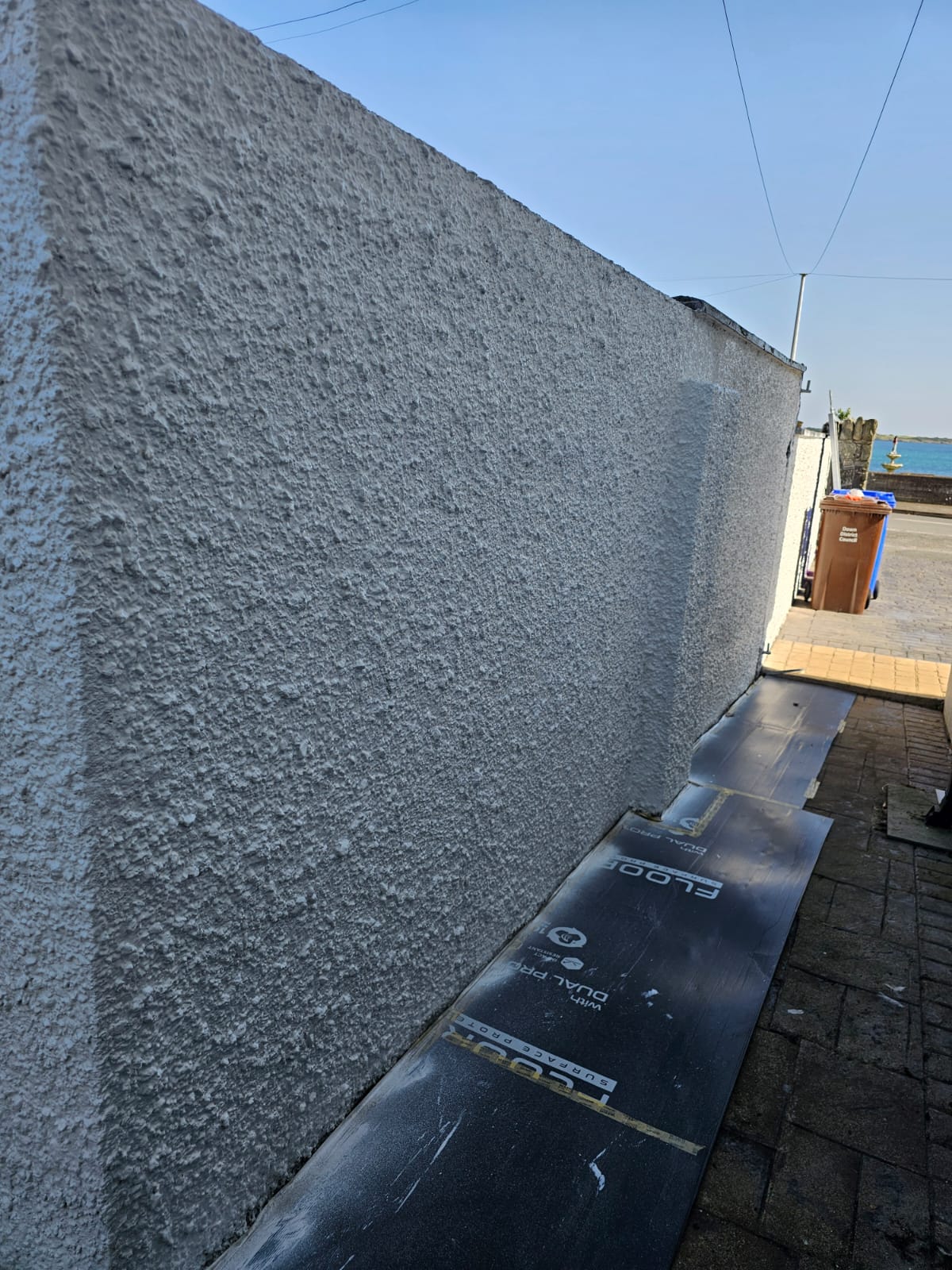
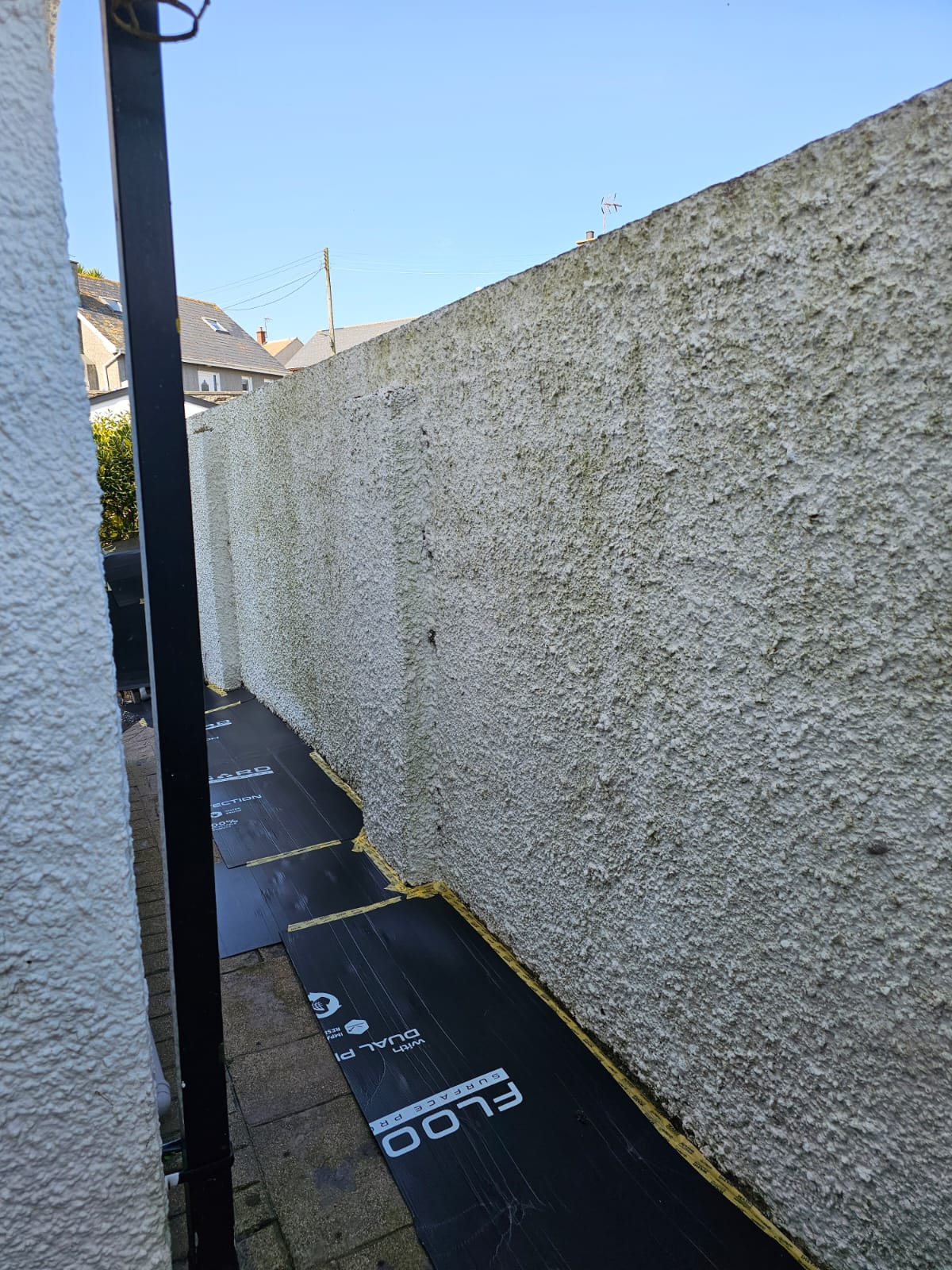
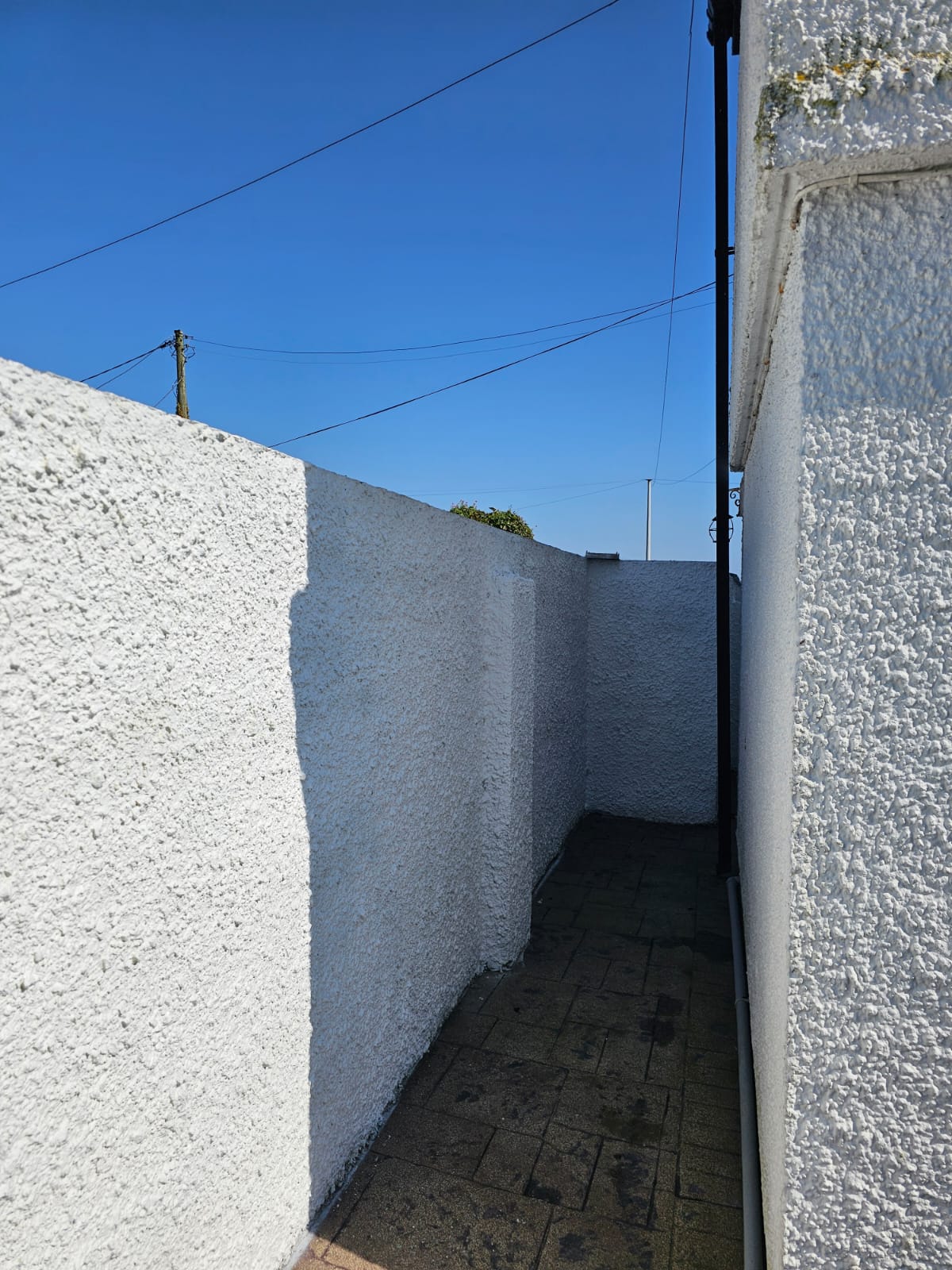
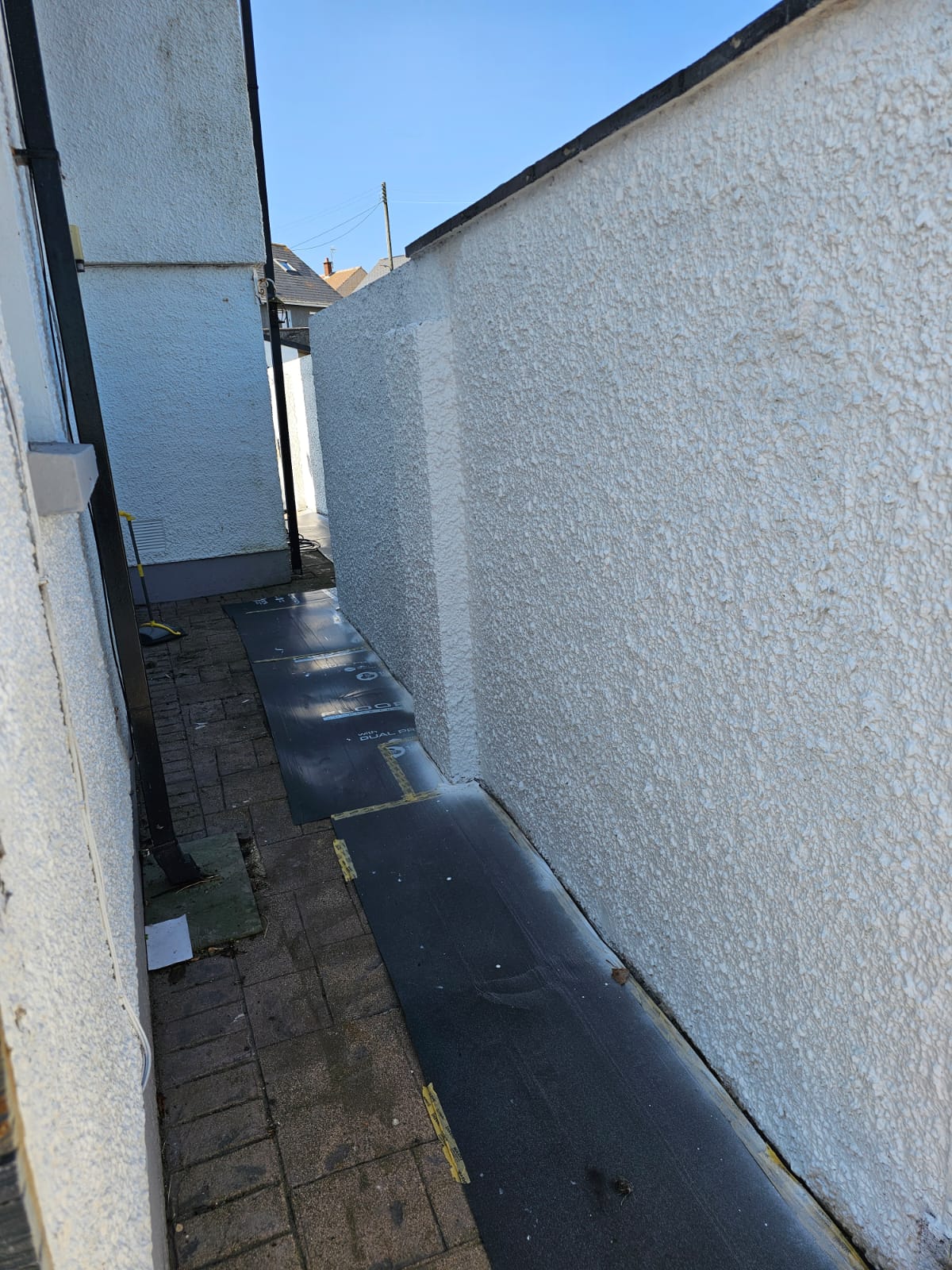
Elevations, sheds and larger areas from jobs we have carried out ourselves.
Related Services
Airless is rarely the only thing booked on a property. These are the jobs it most often sits beside.
Questions we get asked
Airless Spraying Questions
Do you take airless jobs outside County Down?
Regularly. Belfast, Lisburn and Newry are all inside our normal working area and County Down is home ground. Larger exterior and industrial work justifies a longer run than a small job would, so if you are further out it is still worth asking rather than assuming.
How is an airless job priced?
By what has to be covered and repaired, not by the minutes spent spraying. Two identical gables can differ by a day because one has a conservatory, a fuel tank and a hedge under it and the other has a lawn. Tell us what surrounds the surface and the figure will be far closer to the real one.
What happens if overspray lands on something?
It should not, because containment is planned before anything is set up, but we are fully insured and we carry a workmanship guarantee. Neighbouring boundaries are the risk we take most seriously, and on a terrace or a tight driveway we screen and speak to the neighbour before the day rather than after.
How disruptive is it to have the house sprayed?
Windows are masked, so the rooms behind them go dim for the working day and you will not be opening them. The drive is out of use. Beyond that the work is outside, there is no dust from sanding render, and most houses are back to normal the same evening the masking comes down.
When can the garden and drive go back to normal?
As soon as the masking and sheeting are lifted, which is usually the final hour of the last day. Furniture, bins and pots go back then. Avoid leaning anything against a freshly coated wall for a few days while the film reaches full hardness.
What does a tip number like 517 actually mean?
The first digit doubled gives roughly the fan width in inches at a foot from the wall, so a 5 is about ten inches across. The last two digits give the orifice in thousandths of an inch, so 17 is seventeen thousandths. Together they set how wide the pattern is and how much material lands inside it.
Will spraying fill in the texture of my render?
No, and that is one of the reasons we spray it. A correctly sized tip drives coating into the profile and coats the hollows without bridging them. Texture only gets lost when far too much material is laid on in one place, which is a setting fault and an operator fault rather than something airless does by nature.
Do you still use a brush at all on an airless job?
Yes, for cutting in. A spray fan has soft edges and it cannot be run tight against a surface that is staying as it is, so junctions, tight returns, behind downpipes and anywhere against a boundary are done by hand first. Anyone claiming a spray job needs no hand work has not done many.
Does the paint have to be thinned for airless?
Usually far less than people expect, and often not at all, because the pump is doing the atomising rather than relying on the material being runny. Over thinning is a common fault. It gives you runs, poor film build and a coating that no longer meets the manufacturer's own specification, so we work to the stated limit rather than by eye.
Is high pressure spraying safe to have going on at my property?
It is, with the controls used properly. The pressures involved are genuinely dangerous at the gun itself, which is why the tip guard stays on, the trigger is locked whenever the gun is set down, and pressure is released before any tip is touched. Our side of it is competence. Your side is simply keeping people and pets away from the working area.
Is a fence better sprayed or brushed?
Sprayed, almost always, provided what sits either side of it can be protected. A brush cannot reach between close boarded slats or under rails without taking hours, and a sprayed fence gets an even film on every face. If the fence backs onto a neighbour's planting or a parked car, that changes the answer and we will say so.
Request a Free Estimate
Tell us what the surface is, roughly how big it is, and what sits under and beside it. That is enough for us to price the masking properly.
Price Up a Large Area
Send a photograph of the elevation or the building and tell us what surrounds it. We will come back with a realistic number of days and an honest view on whether airless is the right machine for your surface.